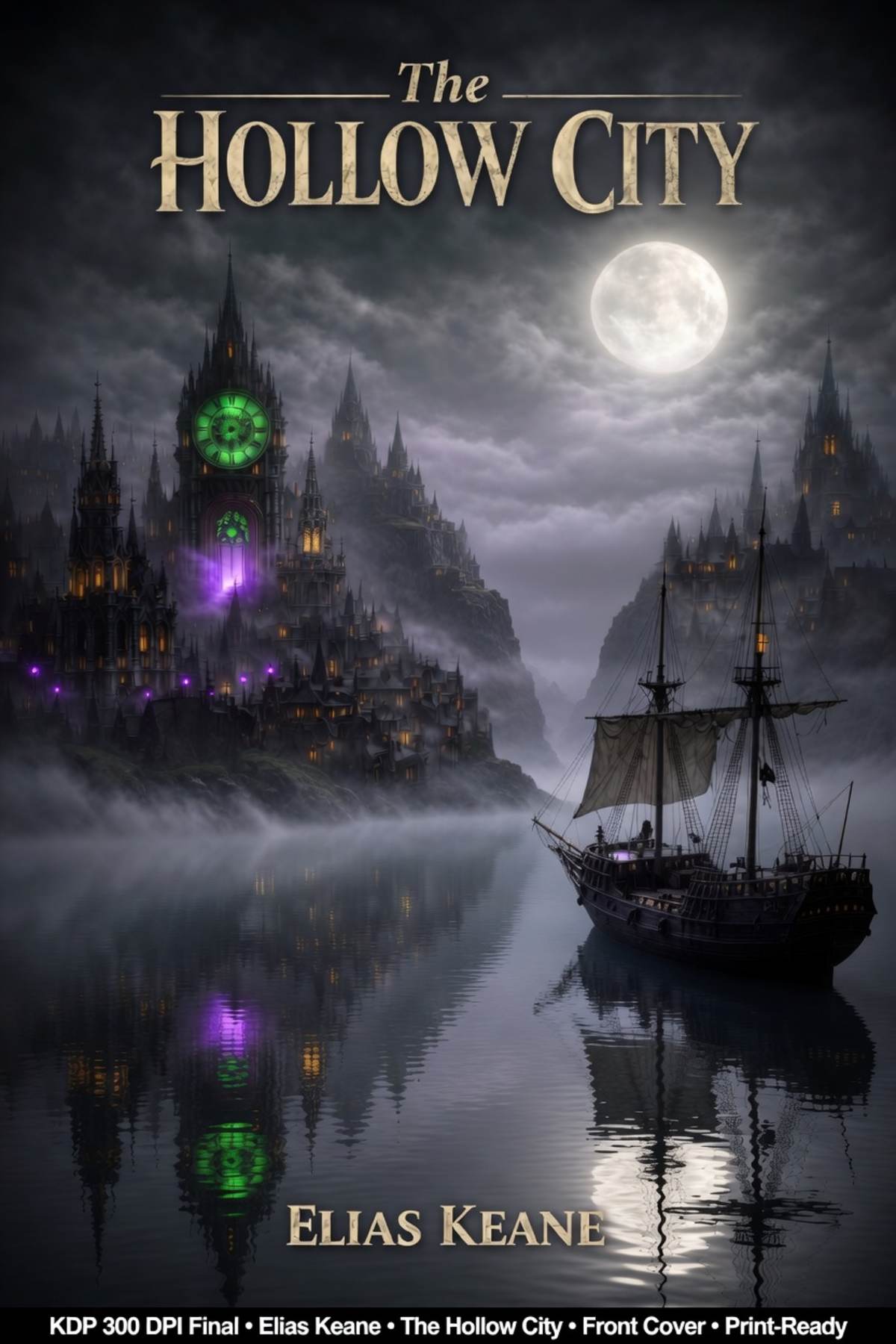
Finishing the Record
I have begun the third book. Its name is The Hollow City, and it is the end of Callum Vane's story.
I want to say that plainly, because I made a decision about this book that surprised me, and the decision is the whole reason it exists in the shape it does.
For a long time I thought the third book was a leaving story. After everything that happens in The Hollow Cathedral, the obvious next move is out, onto a ship, across the water, into the cities my characters have only ever heard rumors of. There is a whole world beyond Hollowmere, an empire that built Hollowmere, and somebody has to go and ask what that runs on. I had pages of it. I was excited by it. I still am excited by it. I love the world that I have built and want to explore more of it.
However, I realized I was writing two books at once, and forcing them to be one.
Because Cal's story is not a leaving story. It never was. From the first page of the first book, Cal has been a man trying to come home to himself, to say his own name in public, to choose the person he loves where everyone can see, to stop hiding. A man like that does not get his ending on a ship sailing away. He gets it in the city that broke him, with the work finished. So I have decided to split the books. The Hollow City stays in Hollowmere and closes Cal's story properly. The leaving story — the wider world — belongs to someone else, and I will come to that at the end.
People ask me where a book starts, and this one started with an unfinished list.
At the close of the first book, Cal frees the souls bound into the city's machinery — most of them. But the oldest bindings, the ones woven in during the first experimental decades, before the Vanes' understood the mathematics of what they were doing, were threaded too deep to lift. Those souls did not leave. They are still down there, in the Ash Quarter, so old they have forgotten the shape of their own names. Cal wrote them into his Record as unfinished business. He told himself he would come back for them. I need to honor that promise.
The Hollow City is him coming back. The book is about a man going down into the deepest part of the place that hurt him, to finish a list he has been keeping since before he knew it was a list. That is the idea. Everything else is built to serve it.
When I set out a book, I start with the emotional question, before I write a single scene. The first book asked whether one man could choose himself. The second asked whether two people could choose each other in public. The third asks the hardest one of the three: is a person ever allowed to put the work down? Cal has spent three books as the one who hears, the one who witnesses, the one who writes the names so that someone will know these people were real. The book is about what it costs to carry that, and whether you are ever permitted to set it down and simply live. The answer the book reaches is the ending of his story.
Then comes the anchor. Every book in this series has orbited one physical object — the clock, then the cathedral. This one orbits the Record itself, that satchel of names Cal has carried since the asylum. And the Record does something useful for pacing that I want to be honest about as a craft choice: it is a finite list. A conclusion is dangerous to pace. It wants to go slow, elegiac, soft. The risk is that it goes slack. But a list of unwritten names is a countdown. Every chapter crosses some off. The book is over when the list is. That gives a quiet, restitutionary final act the one thing it needs — a clock of its own.
I have also had to write this book in a lower gear than the first two on purpose. Book one was a locked building and a ticking clock. Book two was a freezing city in crisis. The instinct is to make the finale the loudest of the three. I am looking to do the opposite. The Hollow City is the city the morning after — slower, colder, stranger, a place learning to live with what it has admitted about itself. The tension does not come from escalation. It comes from the question of whether something this broken can be allowed to heal, and whether the people who broke it get to be the ones who stay.
Underneath all of it, the thing I always seem to be writing — but this time turned to face its hardest version. The distance between what people do when no one is watching and what they let others see. For three books that distance has been Cal's private burden, a record kept in the dark, names nobody else would say. This is the book where it stops being private, where the thing done in secret is finally looked at in the open.
But there is a question underneath that one, and it is the question this whole trilogy has been walking toward. Not who did this. We know who did it. The harder question — the one I have to answer if the ending is going to mean anything — is why did everyone let them?
Because the true villain of these books was never a man. By the end of The Hollow Cathedral, the evil has assumed total power, and it holds that power the way real evil almost always does: not by terror, but by consent. The Church told a city that its dead were a holy necessity — that the suffering beneath the streets was the price of order, that to question the mechanism was to question God Himself. And the city believed it. For sixty years, decent, ordinary, loving people walked over the bound and the screaming and felt nothing, because an institution they trusted had assured them there was nothing to feel. The horror never had to hide. It had become mundane. It had become accepted. It had become faith.
That frightens me, as a writer and as a person, far more than any villain could. I keep thinking about how often it has been true — how many times ordinary people have handed their conscience to an institution and let it tell them that cruelty was righteousness. And it is not only history. We are watching it now, in our own world: faith that was meant to be a shelter, a tool of love and acceptance, bent into a weapon — and standing behind the weapon, as always, the people who profit from aiming it. The robes change. The reasoning does not. This is necessary. This is ordained. The ones who suffer deserve it, or do not matter, or are not really suffering at all. And good people nod along, because it is easier to belong than to look.
So the end of this trilogy cannot only be Cal defeating a villain. That would be too small, and far too comforting. The Hollow City has to be about a city defeating its own acceptance — about ordinary people finally looking directly at what they agreed to, and withdrawing the one thing the evil cannot survive without. The doctrine does not fall because someone smashes it. It falls because the congregation stands up and walks out, and there is no one left to wear the robes. Cal's return sets the machinery free. But the city has to free itself, and the only way it can is by asking, at last, the question it spent sixty years refusing: why did we believe this, and why did we let them? If I get that right, it is a fitting close to these three books — and maybe it says something true about more than Hollowmere.
And then, the part I am most quietly excited about. Cal's gift burned out at the end of the second book. He cannot hear the souls any more. But the boy he and Fen are raising can. There is a child in these books who hears what Cal no longer can, and The Hollow City is where the witnessing passes from one generation to the next. Cal's story ends at home. The boy's story is only beginning — and his goes out into the wider world, onto the ship, into the empire and the cities beyond. That book is called The Hollow World, and it is his.
But first, Cal comes home. I owe him that, and so does the city.
Three questions for you
While I am at the beginning of this, your voices can actually shape what I write — so I want to ask.
The first. Hollowmere runs on bound souls. Coal existed. Gas existed. The whole horror of these books rests on a city that chose the dead over the obvious, easier fuel sitting right there — and I have always known why, but I have never told you. The answer lives in the first experimental decades, before the Vanes understood what they were building, when a choice was made that doomed everyone who came after. I have been wondering whether to write that story: a prequel novella about why a city would burn people when it could have burned coal. Would you want to read it? It would be short, dark, and the origin of everything. Tell me yes or no — I am genuinely asking.
The second, and more useful to me right now. The Hollow City is the end of Cal's story, which means it is my last chance to answer the things you have been carrying since the first book. So: what do you need this book to answer? What loose thread, what character, what unspoken question has stayed with you? I cannot promise to resolve everything — some doors are meant to stay open for The Hollow World — but I am reading every reply, and the right question from the right reader has changed the shape of a book before now.
And one I am asking less as an author than as a person who cannot stop turning it over. The thing I most want this book to reckon with is not the evil itself but the acceptance of it — the sixty years a whole city nodded along. So I will put it to you: why do you think people accept it, when an institution they trust tells them that something terrible is necessary, or holy, or simply the way things are? Why is it so much harder to look than to belong? I am not after the tidy answer. I am after yours. It may well end up shaping the heart of the book.
Reply here, write to me through the contact page, or find me on the mailing list. I read all of it.
email: eliaskeanebooks@yahoo.com
I will keep you posted as it takes shape. Thank you, as always, for being here and letting me share the work while it is still wet.
Yours,
Elias
P.S. For anyone new: The Hollow Clock and The Hollow Cathedral are both out now and can each be read on their own. The Hollow City is the third and final book of Cal's arc — it is coming together but no release date yet. After it, the saga continues with a new pair of eyes and a much bigger map. More on that when the time is right.