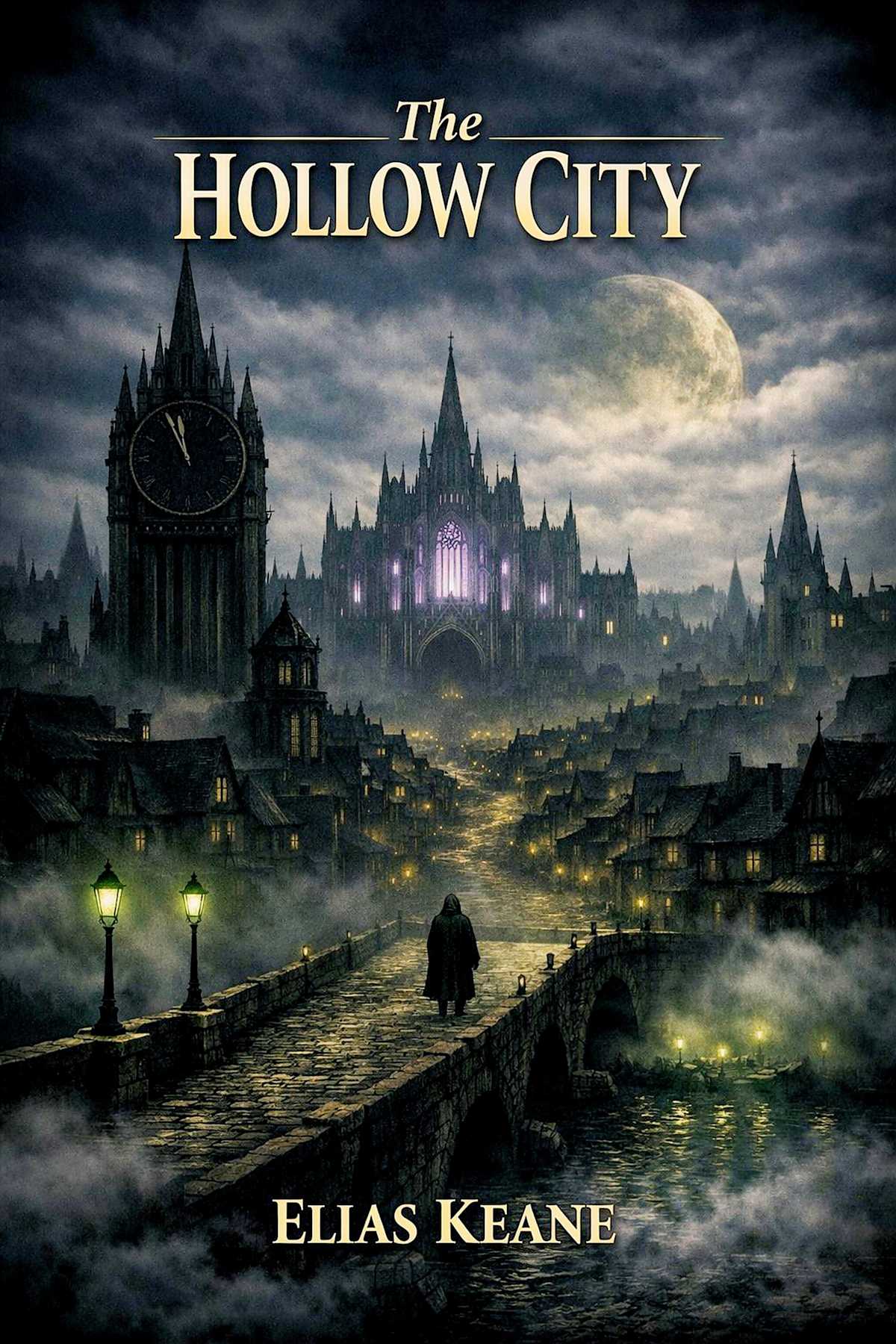
Four days. After three books, a prequel novella, and more hours inside Hollowmere than I can honestly account for, the Hollow Clock Saga finishes on Wednesday.
I want to say something about what it took, because I think the making of a book is worth more than the marketing around it.
The Hollow City was the hardest of the three to write, and the reason is structural. A finale has to pay off promises made years earlier by a writer who was, in several respects, a different person. Every thread the first book laid down had to come back changed rather than merely resolved.
The clearest example I can give you without spoiling anything: William Vane's failsafe. Book One handed Cal an inheritance and a family name he never chose, and told you the failsafe worked. In this book Cal finally sits down with his grandfather's own working papers, the schematics and the carbon copies and the letter written the night before the Cradle went live, and reads what the man actually did. There is a hard boundary drawn on that map. There is a note in the margin about human cost, tidy block capitals, no follow-up. What Cal has spent three books carrying as a debt turns out to be something considerably worse than a debt, and the shape of the rest of the book comes out of that hour at a desk with a dead man's handwriting.
That is the sort of thing I mean by a promise coming back changed. There were passages I rewrote six times because the version that was technically correct still felt like an obligation being discharged rather than an ending being earned.
What I was chasing, the whole way through, was the feeling I get from the books that made me want to write this series at all. Susanna Clarke's Jonathan Strange & Mr Norrell taught me that a magical world holds together better when its magic has bureaucracy, history, and bad manners. Piranesi taught me that a building can be a character and that loneliness can be rendered as architecture. C.L. Polk's Witchmark showed me a gaslamp world where the queerness sits at the center of the story rather than being smuggled in around the edges. Those books are in the DNA of this one, and I would rather say so plainly than let anyone guess.
The ending itself I am not going to talk about. I will say that Cal and Fen get theirs, because they always do with me, and that you will walk through some very cold rooms to reach it. What I set out to write was a happy ending with an invoice attached. The people who make it out the other side pay for the passage, and the city they wake up in on the last page is dark and poorer and honest. Whether that reads as a victory is a question I have deliberately left with you.
I will also say that the last chapter is not quite the last word. Soot's story does not end at the harbor. There is a road out of Hollowmere, and it runs a long way.
All three formats go live on the 29th. Kindle, paperback at $14.99, and a hardcover for the people who want the trilogy standing together on a shelf.
Pre-order The Hollow City: Pre-order The Hollow City →
One last thing. In the front of this book there is an apprentice clockmaker named Genevieve Vonderloch, working at a shop in the Tangle. She exists because a member of the First Light Club won a contest to name a nameless face in the Ash Quarter, and the name went to print. Thank you, Gena. I hope she finds her way into a few more doorways yet.
Thank you for reading this series. Some of you have been here since the first book went up, when I had no idea whether anyone would follow me into a city with a clock at its heart. You did, and it changed what I thought this whole experiment could be.
Yours,
Elias