People ask me where the book came from, and the honest answer is one image I couldn't let go of for a long time before I knew what to do with it.
A body breathing in a quiet room. Nobody inside it.
Everything else came after. The cathedral on the hill with its astronomical instruments drifting slowly out of true. The Arch-Cogitant in his vestments, negotiating with men who already know too much. Ships returning to the harbour with questions nobody wants to answer. Two men at the centre of it trying to build a family in a city that has never let anyone choose anything out loud. All of that came later. The body came first. The book is what I wrote to understand what the body meant.
This is a short account of how the book got built, for readers rather than for other writers. No spoilers.
The City
The book is set in Hollowmere, the coastal capital of an empire that has lived, for as long as anyone alive can remember, on a bargain it does not discuss. The clock at the heart of the city kept perfect time for sixty years. Perfect time meant trains that ran, harbours that opened on schedule, a calendar the empire could sell to everyone else. Perfect time meant power. Hollowmere was the city the rest of the world set its watches by.
When the book opens, the clock is silent. Has been for six weeks. The city is dark and cold for the first time most of its citizens can remember, and for the first time most of its citizens can remember, it's also honest.
I wanted to write a book set in exactly that moment. Not the before, when the bargain still held. Not the after, when a new arrangement has been made. The middle. The disoriented, grieving, clear-eyed middle, when the old thing is gone and the new thing hasn't arrived, and everyone has to decide, one at a time, what they actually believed.
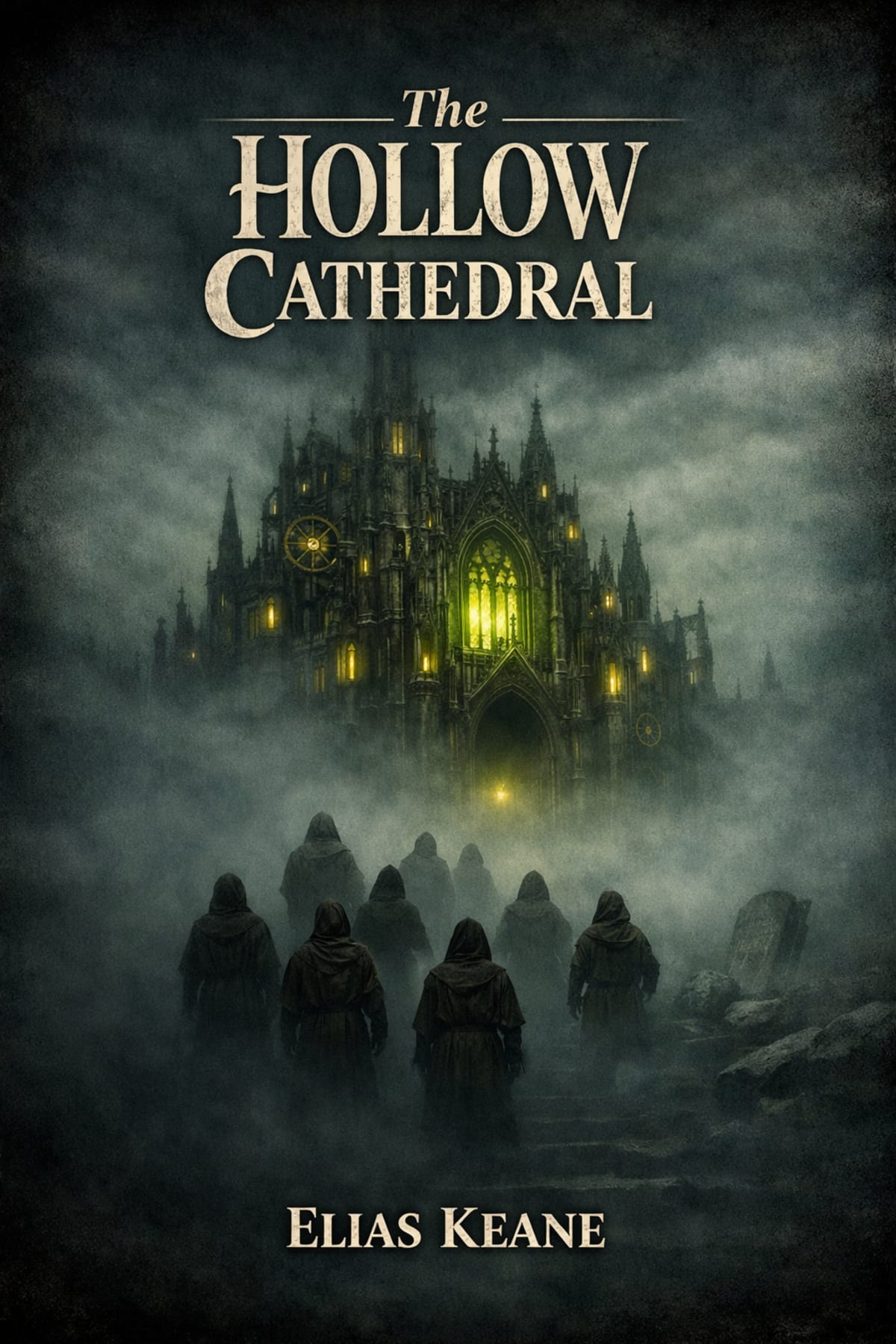
The cathedral of the title is what sits on top of the city now that the clock is gone. It's still standing. Its bells still ring. Its high order still claims authority. Its congregation is still faithful, and their grief for the clock is real. I wanted that part to be real, and I spent a long time making sure it was. Institutions don't survive for generations on cynicism alone. The people inside the Church of the Cog mostly believed what they were told, and most of them still do, and that's what makes the institution dangerous and the book, I hope, complicated.
The Two Men
At the centre of it are two men. One has spent his life being told he's wrong about what he can hear. The other has spent his life being pointed toward a destination nobody told him about. Against considerable odds, they've found each other. The book is partly the story of what it costs to stay found in a city that has always treated private feeling as a problem to be managed.
I wrote the romance the way I wanted to read it. Slow. Specific. Aware that choosing someone out loud in a place that would prefer you didn't is one of the bravest things a person can do. The cathedral setting isn't incidental to any of that. If I could have called the book something else I would have, because titles are a nuisance, but The Hollow Cathedral insisted on itself. The institution and the relationship are the same argument from two directions. You'll see what I mean.
The Horror
It's a horror novel. I want to be plain about that, because the cover is pretty and the love story is real and people sometimes arrive at the book expecting something softer than what they find.
The horror here isn't the kind that jumps at you. It's the kind you walk into and then realise, slowly, you're standing in. An empty room that shouldn't be empty. A ceremony that makes visible, for the first time, what the beautiful thing has always been doing. A congregation singing a hymn that is more correct than anyone in the congregation knows.
I wanted the book to feel the way a cathedral feels. Cold. Vast. Acoustically strange. Full of beauty that was paid for by people you are not permitted to ask about. The horror is the question of who paid, and the answer, when it comes, isn't a monster. It's an institution. Institutions are harder to kill than monsters, and that's the engine the book runs on.
The Room
I said I'd come back to it.
Early in the book there's a room in a quiet inn where a woman's body is breathing without her. People visit her. They bring tea she can't drink. They sit with her. They talk to her in case she can hear. The room is cold when things in the city are going badly. Someone leaves flowers.
I didn't understand, when I started, that the room was going to be the heart of the book. I thought it was a setting. I thought grief was something the characters would talk about and then move past and then deal with in other ways as the plot required. It took me more drafts than I want to admit to understand that the room was not a backdrop. It was a character. It had moods. It had a voice, even if the voice was silence. The book comes back to the room again and again, because the book is, underneath everything else, about what you owe the people you love when loving them is not enough to save them.
If the book has a thesis, it lives in that room.
What I Hope You Find
A city you can smell. Two men you believe in. A cathedral that's beautiful and shouldn't be. An institution you recognise, even if the one you recognise has a different name and a different building and a different god. A love story that takes itself seriously. A horror novel that takes its horror seriously. A book that's generous, I hope, in the ways that matter — to its characters, to its grief, to whoever's willing to walk into its rooms.
The clock stopped. The cathedral is still standing. That's the problem.
Come in. The door will be open soon
Pre-Order on Amazon now - Available May 16, 2026